High School Debate on the Film "Napoleon": Between Historical Fact and Cinematic Fiction
Students in the E.P.I.C. project analyzed the film "Napoleon", exploring historical representation and artistic license, in a classroom debate.
Part of the project: EPIC - Education for Correct Information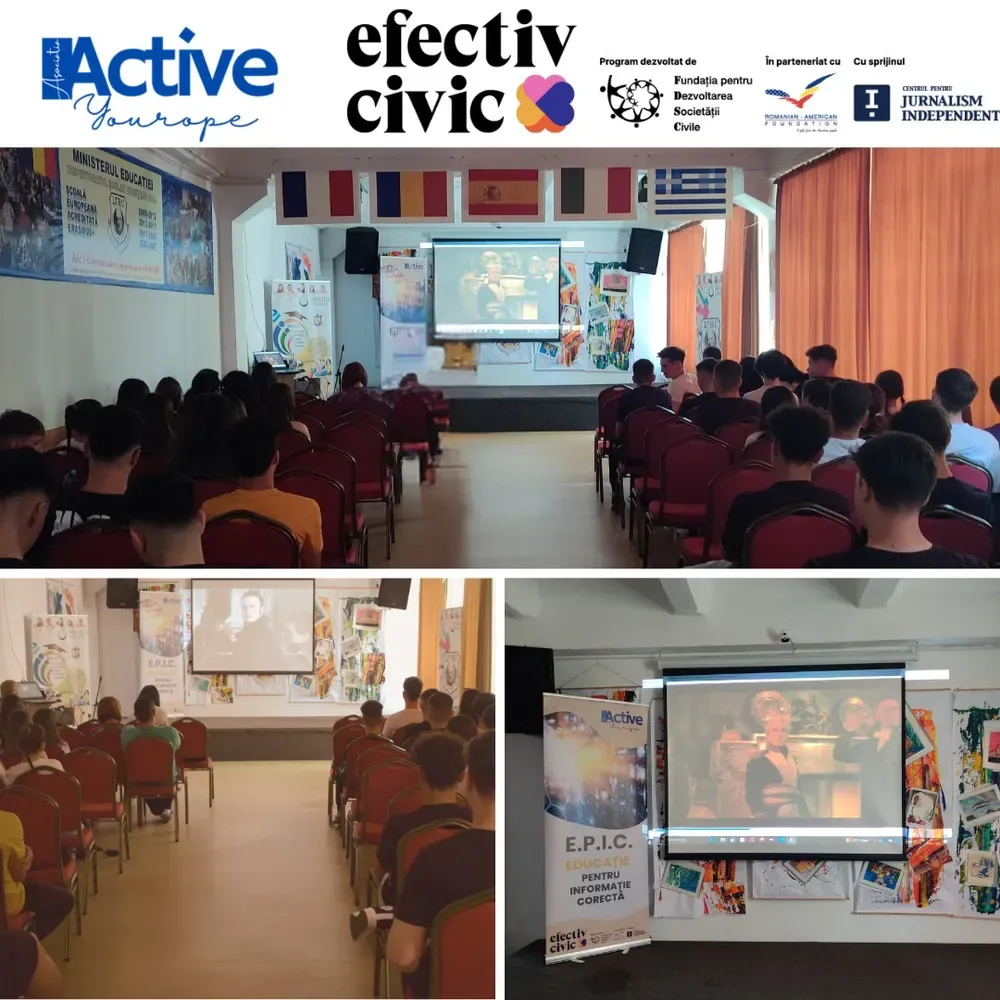
Debate on the film “Napoleon” as part of the E.P.I.C. project: media literacy and historical analysis
As part of the E.P.I.C. - Education for Correct Information project, high school students recently took part in an engaging debate about the film “Napoleon”, with the main goal of exploring how cinema portrays historical figures. Students analyzed in detail the complexity of Napoleon Bonaparte, comparing the film’s artistic portrayal with documented historical facts.
The E.P.I.C. - Education for Correct Information project
This project is run by Active Yourope and funded through the Civic Innovation Fund programme, supported by the Foundation for the Development of Civil Society (FDSC), the Romanian American Foundation (RAF), and the Centre for Independent Journalism (CJI). Its goal is to develop young people’s critical thinking and media analysis skills.
Educational activities before the screening
Before watching the film, students took part in an informative workshop organized by their history and Romanian language teachers. This workshop provided context about the life and achievements of Napoleon Bonaparte, as well as the historical period in which he lived.
The film and its analysis
The screening of “Napoleon” struck audiences with its presentation of the French emperor’s complex personality. He was portrayed as a brilliant military leader, but also as a man with human flaws and vulnerabilities. While the film included artistic licence and dramatic elements, these served as discussion points for the debate.
Students’ debate: historical accuracy vs. artistic licence
After the screening, students took part in a lively debate, guided by their teachers. They analyzed:
- the historical accuracy of the events presented in the film;
- the artistic liberties taken and how these influence public perception of historical figures.
Students expressed their views in a reasoned way, drawing on the information gathered during the workshop and their own impressions of the film. The debate was lively, reflecting a diversity of perspectives.
Educational impact
By comparing artistic representations with historical facts, students gained a deeper understanding of Napoleon Bonaparte and his historical context. The activity also helped develop their critical and analytical skills, preparing young people to assess information and media representations with discernment.