Roots & Routes: A Practical Erasmus+ Handbook for Youth Workers on Migration, Integration and Belonging
Active Yourope contributed to a new Erasmus+ handbook with 20 non-formal methods for youth workers supporting young migrants and refugees.
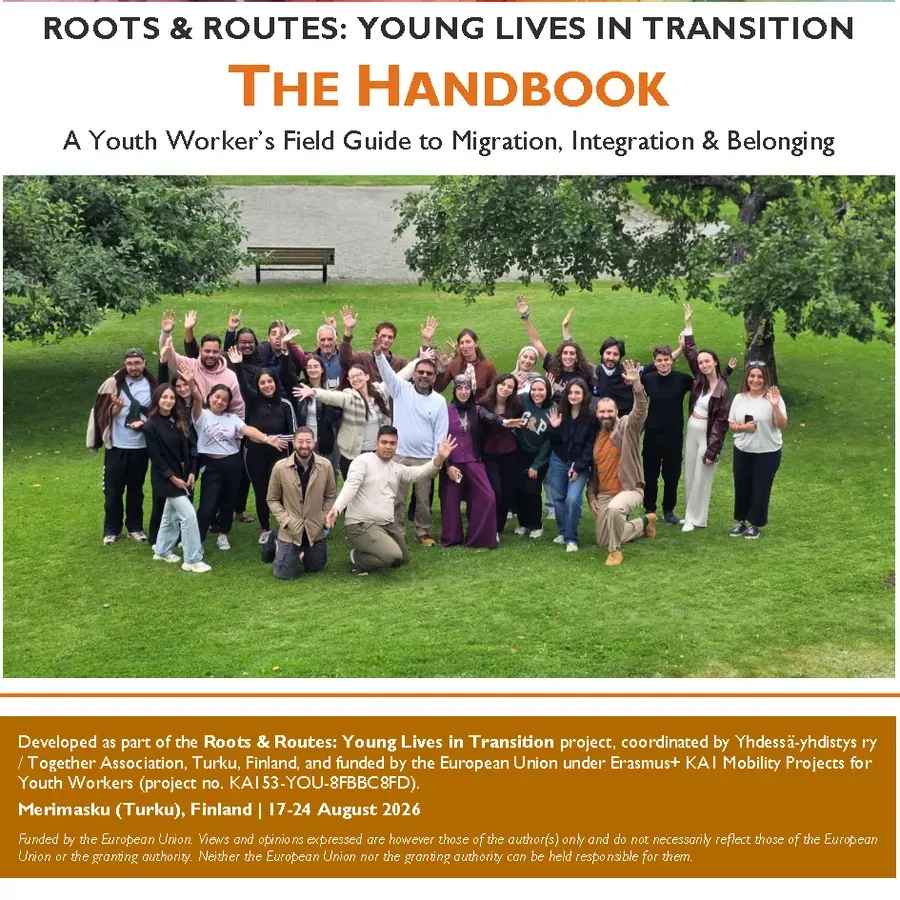
Active Yourope contributed to a new Erasmus+ handbook that offers youth workers practical methods, country perspectives and non-formal education tools for supporting young migrants, refugees and young people with a migration background.
Migration is not only about crossing borders. For young people, it can also mean adapting to a new school, learning a new language, building relationships, finding opportunities and developing a sense of belonging in an unfamiliar community.
These realities were at the centre of “Roots & Routes: Young Lives in Transition”, an Erasmus+ mobility project for youth workers held in Merimasku, Finland, from 17 to 24 August 2026. The project brought together 30 participants from Armenia, Egypt, Finland, Greece, Italy, Romania and Tunisia to exchange experiences, examine migration and integration from different national perspectives, and develop practical approaches that youth workers can use in their own communities.
One of the main results of this cooperation is the new handbook “Roots & Routes: Young Lives in Transition - A Youth Worker’s Field Guide to Migration, Integration & Belonging”.
From an Erasmus+ mobility to a practical resource
The handbook was developed as part of the Erasmus+ KA153-YOU project coordinated by Yhdessä-yhdistys ry / Together Association from Turku, Finland. It was conceived as a working resource for youth workers, trainers, educators and organisations working with young migrants, refugees and young people with a migration background, not as a document to read once and put aside.
It combines three elements:
- an introduction to migration and integration concepts;
- comparative migration profiles from the seven participating countries;
- a practical Toolbox containing 20 non-formal education methods that can be adapted to different youth-work contexts.
The resource grew directly out of the learning activities, discussions, study visits and peer-led workshops organised during the mobility.
Understanding migration through seven different realities
One of the strengths of Roots & Routes was the chance to look at migration through several national perspectives at the same time. The participating organisations explored the realities of Armenia, Egypt, Finland, Greece, Italy, Romania and Tunisia.
These countries occupy very different positions in contemporary migration patterns. Some have long been countries of arrival, others are traditionally associated with emigration, and some are at once countries of origin, transit and destination.
Despite these differences, several challenges emerged across the seven national contexts: language barriers, unequal access to education and services, legal-status restrictions, discrimination, hate speech and the dependence of integration support on short-term projects. The handbook therefore encourages youth workers to look beyond statistics and understand how migration policies and social conditions affect the everyday lives of young people.
Romania: from a country of departure to a country of arrival
Active Yourope contributed to the Romanian perspective included in the handbook. Romania has historically been associated with large-scale emigration, but recent years have brought important changes. The country is increasingly becoming a destination for people arriving for employment, international protection or other reasons, while many Romanians continue to return after living abroad. This changing reality creates new challenges for schools, public institutions, NGOs and youth organisations.
The Romanian profile highlights, among other issues, the importance of access to Romanian-language learning, educational support, reliable information and community-based integration activities. It also underlines the role of civil-society and youth organisations in creating spaces where young people can participate, build relationships and access opportunities.
For organisations such as Active Yourope, this reinforces the importance of combining non-formal education, inclusion, media literacy, intercultural dialogue and active participation in youth work.
20 methods youth workers can actually use
A central part of the handbook is its Toolbox of 20 practical methods. Ten were developed and tested during the mobility - nine by the national teams and one by the training team - while ten more were adapted from resources developed by organisations and networks such as the Council of Europe, SALTO-YOUTH and Verke.
The activities address six interconnected areas: intercultural dialogue, identity and belonging, participation and access, countering racism and hate speech, language and communication, and first contact and trust.
Among the methods included in the handbook are:
- The Ladder of Integration;
- Take a Step Forward;
- Human Book;
- Photo Voice: What Integration Looks Like;
- Forum Theatre: Stop the Scene;
- Game On, Hate Off;
- A New Mosque in Sleepyville;
- Our Voices Podcast;
- Opportunities Mapping.
Each method provides practical information on the recommended group size, age, duration and delivery format, as well as step-by-step instructions and suggestions for debriefing. Every method also includes a “Watch out for” section, which draws attention to issues such as consent, accessibility, legal status and potentially traumatic experiences. The basic principle is clear: young people should never be pressured to disclose their migration status or personal experiences in order to take part in an educational activity.
Active Yourope’s contribution: Opportunities Mapping
The Romanian contribution to the Toolbox is “Opportunities Mapping - Harta Oportunităților”, a workshop connected to the experience of Active Yourope and Oportune.
Its starting point is simple: young people often miss valuable opportunities not because they are unable to take part, but because they never receive the information in the first place.
During the activity, participants create a shared map of real opportunities such as Erasmus+ mobilities, volunteering programmes, traineeships, entry-level jobs, events, mentoring programmes and funding opportunities. But finding an opportunity is only the first step. Participants also verify whether there is a real organisation behind it, whether the deadline is still valid and whether applying is genuinely free. In this way, the activity combines access to opportunities with media and information literacy.
This is particularly relevant for young newcomers, who may face additional barriers related to residence status, visas, costs, language or lack of local networks. The method therefore encourages facilitators to include local, remote and fully funded opportunities rather than assuming that every participant has the same freedom of movement or financial resources.
From theory to practice in Turku
The mobility also showed how important it is to connect theoretical discussions about integration with real-life practice. Participants explored migration terminology, push and pull factors, integration policies and national contexts, but also took part in experiential activities and study visits in Turku. The programme included encounters with local integration structures and youth-work environments, showing how municipalities and community organisations respond to diversity in practice.
One lesson was that practice should not simply illustrate theory: practical experiences can also become the starting point for reflection and learning. Peer learning was equally important. Participants brought methods from their own organisations, tested them with colleagues and transformed them into resources that others can now use.
Learning that continues beyond the mobility
The final evaluation confirms the value of this practical approach. Participants gave particularly strong feedback to the practical tools developed during the project, and their willingness to recommend a similar mobility reached 9.65 out of 10.
More importantly, the learning process produced something transferable. The methods, country profiles and lessons collected in the handbook can now be reused by youth workers far beyond the group that met in Finland.
For Active Yourope, taking part in Roots & Routes is part of our continued commitment to European cooperation, inclusive education, youth participation and the development of practical non-formal learning methods. International mobility becomes truly valuable when the knowledge gained does not remain with the participants, but is transformed into resources that can be shared, adapted and used by others.
Explore the Roots & Routes handbook
Youth workers, trainers, educators and organisations working on migration, inclusion, participation, intercultural dialogue or the prevention of hate speech are invited to use the handbook in their own work.
Download the “Roots & Routes: Young Lives in Transition” handbook (PDF, in English) and discover 20 practical methods for supporting inclusion, participation and belonging. It is also listed with our other project materials on the For Schools page.
“Roots & Routes: Young Lives in Transition” was funded by the European Union under Erasmus+ KA1 Mobility Projects for Youth Workers, project no. KA153-YOU-8FBBC8FD. Views and opinions expressed are those of the authors and do not necessarily reflect those of the European Union or the granting authority.